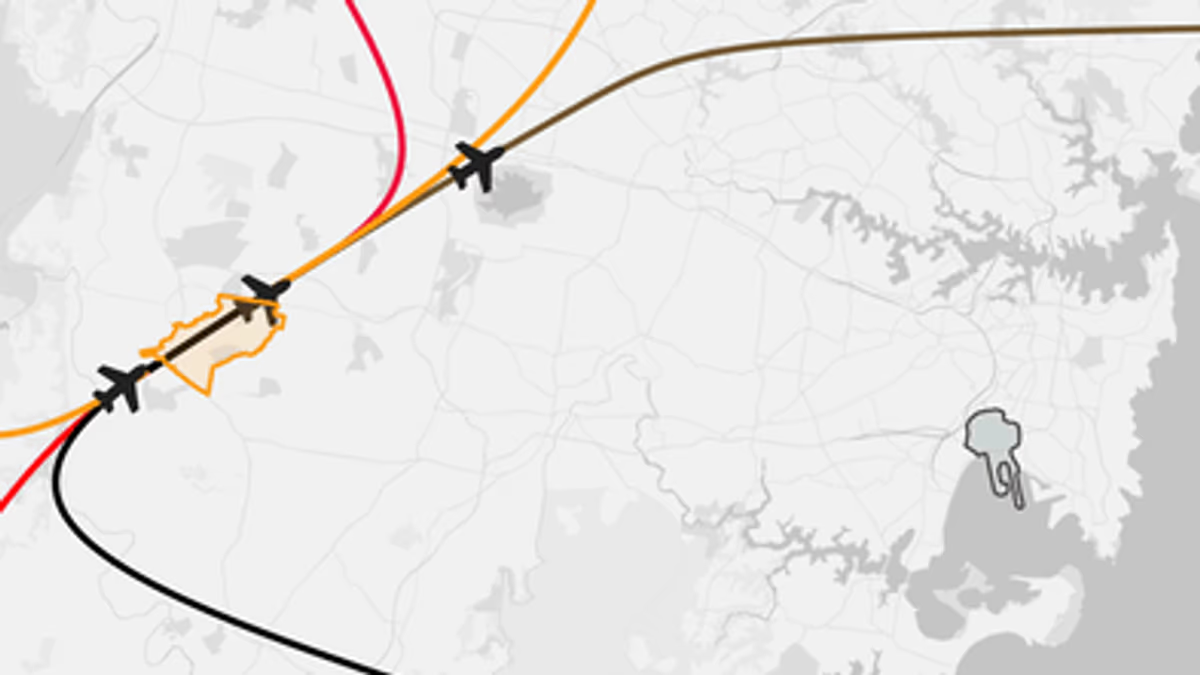
Western Sydney International Airport opens this Sunday, but its launch will be modest: just seven airlines have committed to operate from the new hub, combining for roughly six return flights a day across domestic and international services.
The airport sits about 50 kilometres west of Sydney’s CBD and arrives at a time when global fuel costs are high, with crude oil trading above $US100 a barrel, and airlines face shortages of new aircraft and pilots. Those conditions make carriers cautious about opening uneconomical routes.
The new facility has a major operational advantage over Sydney’s established hub: it is curfew-free. That should help relieve pressure caused by Sydney Kingsford Smith Airport’s strict night curfew, frequent weather disruptions and air traffic control staffing problems, which together constrain capacity at the eastern airport.
Commitments announced so far are limited in scale. Qantas will start services from Western Sydney on 28 March 2027, using 95-seat QantasLink Embraer E190s for four return flights a week to both Brisbane and Melbourne. Air New Zealand will operate three weekly services from Auckland, Singapore Airlines has one daily return, and Qatar Airways has confirmed plans but not until late 2027.
Low-cost carriers have made larger commitments. Qantas-owned Jetstar plans up to 24 return services a week, including up to 14 to Melbourne, daily flights to the Gold Coast and three weekly services to Brisbane. Vietnam’s Vietjet will run two weekly return flights to Ho Chi Minh City from January, while Vietjet Thailand is expected to begin four weekly flights to Bangkok in November 2027.
The airport and the New South Wales government have sweetened the deal for airlines with a $16 million Western Sydney International Take-Off Fund to help cover operational fees. Senior aviation consultant Ian Guy warns that such subsidies can only get routes started: if the economics do not stack up when payments end, airlines may withdraw services after a season or two.
Ellis Taylor, Asia editor at aviation analytics firm Cirium, expects demand at Western Sydney to be slow to build and sees the airport initially serving a different market to Kingsford Smith. She says it will cater more to leisure and to visiting friends and relatives travel, where passengers fly less often but in larger groups and with more luggage, a pattern that suits an airport whose patrons are likely to arrive by car.
The airport’s opening could reshape some domestic links. Perth-based consultant Bill Meeke notes that Sydney’s curfew and the time difference with Western Australia limit daily windows for Perth services, and a curfew-free western airport could open new scheduling options. Network planners also point to the possibility of WSI becoming a useful intermediate stop for overseas carriers trying to stitch together domestic feeds into international departures.
If Western Sydney’s early services prove profitable that will encourage carriers to expand at the site, according to industry figures. As traffic grows, Sydney Airport may have to accommodate larger aircraft and shift capacity strategies, but for now Kingsford Smith remains effectively near capacity with roughly 400 return flights a day across almost 60 airlines.
Former IATA business strategist Tony Laverghetta put the change in plain terms:
"Many big cities globally have two or more commercial airports. It was absolutely necessary here as well."
The first operating months will also test ground transport links and the strength of demand from Sydney’s west. When the new metro line opens, Laverghetta and other industry observers expect connectivity to improve, which could strengthen the business case for more airlines to base services at Western Sydney.
For now, the airport launches with a small cohort of airlines and a patchwork of short- and medium-term incentives, and the expansion of its route map will depend on how those early services perform against rising fuel and operating costs.