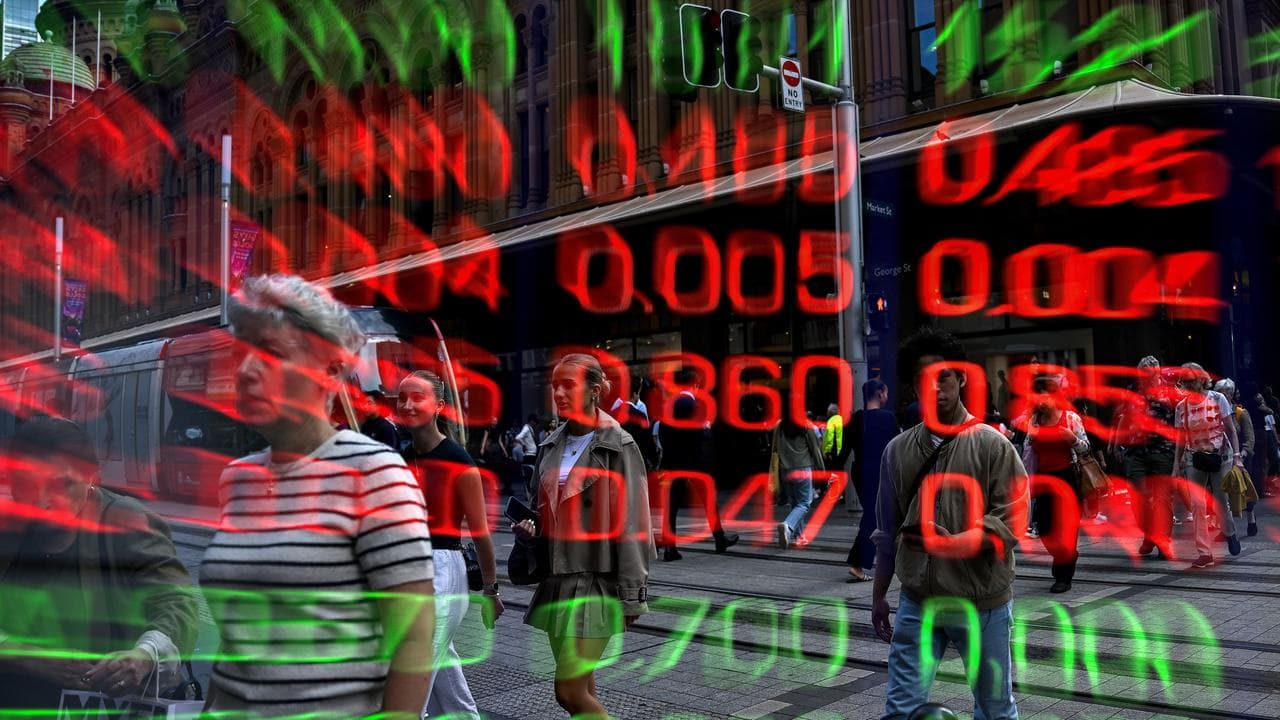
ASX futures signalled a weaker open on Friday, pointing to a fall of 29 points, or about 0.3%, after a volatile session on Wall Street sparked by a sudden leadership change at Nvidia and a jump in oil prices.
US markets swung during the day but moved into the green by mid‑afternoon: the S&P 500 was trading 0.2% higher, the Dow Jones Industrial Average had added 175 points (about 0.3%), and the Nasdaq composite was up 0.2% after wiping out an earlier decline.
At the centre of the volatility was Nvidia, whose share price plunged about 14% at the open when the company announced CEO Jensen Huang had resigned amid an internal investigation into a relationship with a woman suspected of being a Chinese government agent. Nvidia later pared most of that early loss and was trading down roughly 4.7%.
Nvidia’s stock has been a dominant force in recent years, having risen about 1722% over four years to a record last month. The company’s market value had already fallen roughly 27% from that peak through Wednesday as investors fretted over Huang’s future; the board named chief financial officer Colette Kress as interim CEO.
Other AI and semiconductor names also swung sharply. CoreWeave fell 6.5%, Micron Technology dropped 2.3%, while rival chipmakers Broadcom and Advanced Micro Devices rose 5.8% and 5.6% respectively, suggesting some investors expect market share to shift rather than the AI boom to stall. GE Vernova moved from an early loss to a gain of about 2.3%.
Energy markets added to the turbulence after former US president Donald Trump said he was no longer seeking a deal with Iran, comments that briefly pushed Brent crude from about US$92 to over US$94 a barrel. The contract was last at US$94.47, up 1.8%, and helped lift oil and gas stocks such as Marathon Petroleum, up 3%, and ExxonMobil, up 1.8%.
“We don’t need a deal with Iran,” Trump wrote. “Those days have long since passed. We’ve got their money, Hundreds of Billions of Dollars, and we’ve got their Strait!”
The oil rally fed through to fixed income markets: the US 10‑year Treasury yield rose to 5.10% from 4.98% late Tuesday. Higher yields make borrowing more costly for governments, companies building AI data centres and households with mortgages, a connection that analysts and traders flagged during trading.
Data out of the US underlined how higher borrowing costs are weighing on activity: sales of previously occupied homes fell to their slowest pace in more than 16 years in October, and weekly jobless claims inched up, though remain low by historical standards.
Locally, the ASX had slipped by less than 0.1% on Thursday and the Australian dollar was weaker, trading around US68.05¢. Australian investors will be watching tech and energy sectors closely at the open, given the moves in Nvidia, other chipmakers and oil prices.
Markets in Asia and Europe reflected the nervous tone: Hong Kong’s Hang Seng fell about 1.3%, while European indexes were mixed following a softer finish across much of Asia. Analysts noted that Nvidia continues to sell AI chips at pace and remains a leader in the sector, a factor that helped trim the company’s early losses and calm some market jitters.