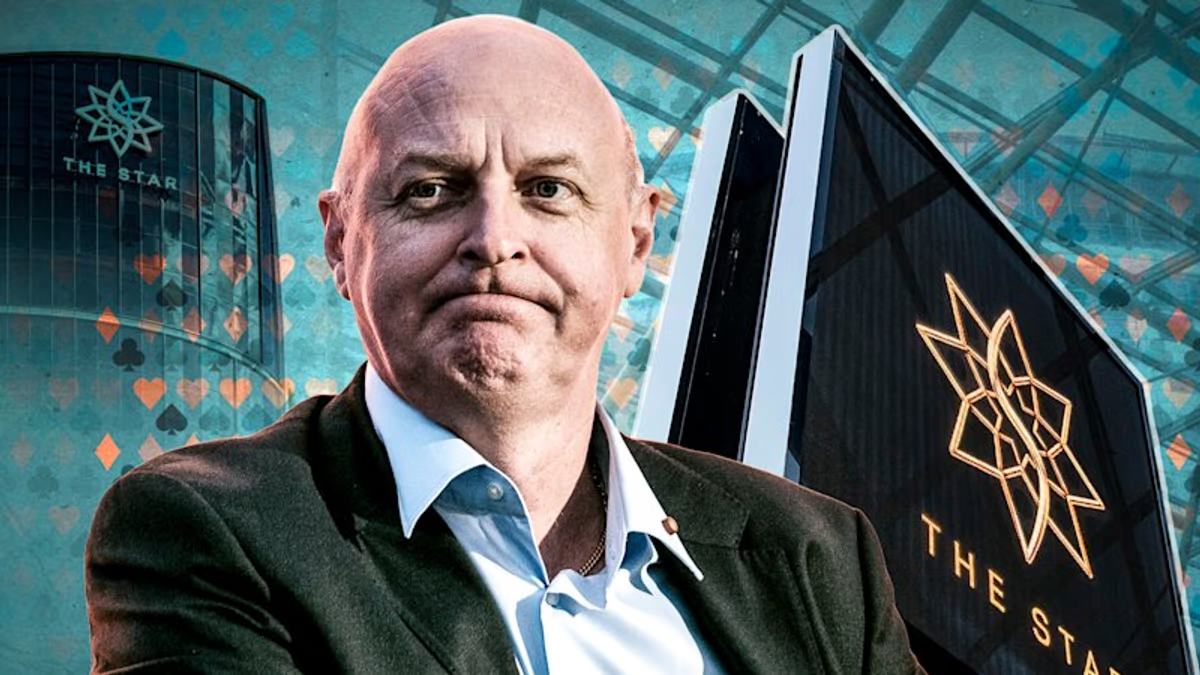
The Federal Court will hand down its decision on Wednesday morning over how large a penalty Star Entertainment must pay for repeated breaches of anti‑money laundering laws, a ruling that the casino operator says could threaten its survival.
Regulator AUSTRAC has argued for a penalty of $400 million, while Star told investors in its annual report that a penalty “greater than $100 million, payable in the 12 months following the hearing, would be challenging” given available liquidity options.
Shareholders will gather in Sydney on Tuesday for the company’s annual meeting, the first opportunity for investors to meet new chairman Soo Kim and chief executive Bruce Mathieson Jnr ahead of the court decision. Mathieson Jnr led the $300 million rescue package that staved off collapse last year, with the Mathieson family contributing $100 million and US operator Bally’s taking effective control.
Star’s legal and regulatory troubles began after 2021 media investigations alleged the company had allowed suspected money laundering, organised crime links, large‑scale fraud and foreign interference at its casinos even as board warnings raised concerns about failing anti‑money‑laundering controls.
Those revelations triggered a string of inquiries, the suspension of Star’s casino licences in NSW and Queensland, a protracted legal dispute with the corporate regulator and the AUSTRAC prosecution now before the Federal Court.
The company says gambling revenue has fallen and regulatory costs have increased as it implements reforms under new oversight. Star warned investors in August that the size of the impending fine posed an “existential” risk to the business if it was too large.
A leaked recording published this year captured senior executives complaining about the burden of compliance. In that recording Mathieson Jnr said:
“We get these fines, which I think are just disproportionate to what is happening, and … all we’re doing is existing to pay a fine.”
The New South Wales Independent Casino Commission has continued to scrutinise the operator. Commission chief Philip Crawford last month extended the suspension of Star’s Sydney licence, saying progress had been made but recent allegations about governance, leadership and culture remained serious and were being treated accordingly.
Recent investigations by this publication and the Australian Financial Review also questioned whether Star’s reforms are sufficient for regulators to restore its licences, adding to uncertainty for the business, its workforce and suppliers as it seeks to meet tighter compliance conditions. The court’s penalty determination will shape whether Star can continue operating under the new ownership and management structure.