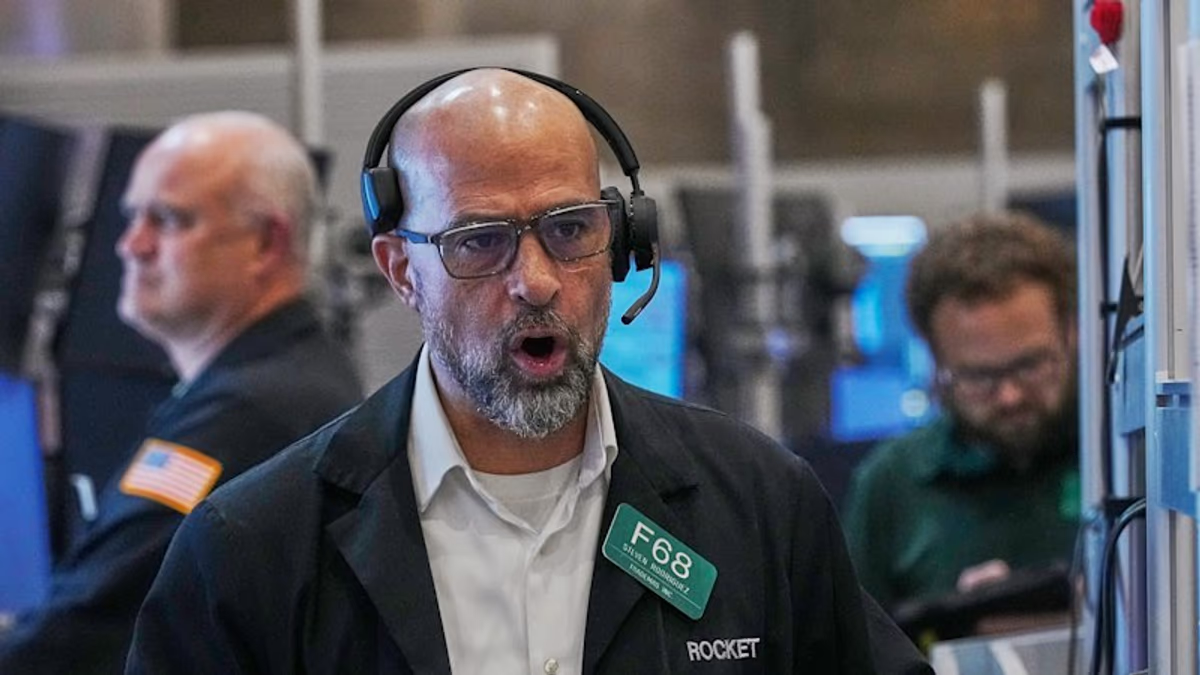
Wall Street sank on heavy selling in AI chip and data centre-linked stocks, with the S&P 500 falling 3.9% and the Nasdaq composite sliding 5% as losses accelerated through the morning.
The Dow Jones Industrial Average dropped about 1670 points, or 3.1%, in midday trade, leaving traders on edge and pushing Australian share futures to indicate a roughly 49-point decline, or 0.5%, at the open.
Shares of AI-focused and data centre suppliers led the weakness. Nvidia fell 8.4%, while Advanced Micro Devices plunged 15%. Cloud GPU provider CoreWeave tumbled 9.2%, and power supplier GE Vernova lost 6.7% as investors cut exposure to the firms most linked to the AI buildout.
Analysts cited worries that the cost of borrowing is making further construction of AI data centres harder to finance, and that demand for new capacity could slow. Tuesday’s US midterm results also raised the prospect of tighter local controls on data centre approvals in some jurisdictions, which would reduce future purchases of AI chips and related services.
Markets outside the US felt the spillover. South Korea’s Kospi plunged 5.3%, Japan’s Nikkei 225 fell 1.8%, and London’s FTSE 100 dipped 0.4% after the Bank of England raised its main interest rate for the first time in three years.
Oil staged a partial rebound after a sharp drop the day before, with Brent crude up 2.6% to $US97.11 a barrel. The move followed renewed uncertainty around the Iran war and its effect on global energy supplies and inflation.
In fixed income, investors moved back into US Treasuries, sending the 10-year yield down to 4.83% from 4.90% late on Wednesday. The yield had been 4.95% on election night and was above 5.30% last month.
Some pockets of strength emerged in US stocks despite the broad sell-off. AppLovin jumped 30% after revenue and profit topped forecasts and the company approved an additional share buyback of up to $US3.2 billion, taking the potential total to $US3.6 billion. Tapestry, owner of Coach and Kate Spade, rallied 7.6% after lifting its revenue and earnings outlook for the fiscal year.
Bank of England Governor Andrew Bailey said economic developments and the conflict in the Middle East will shape policy decisions.
"The best thing that can happen is to resolve the conflict in the Middle East; there’s no question about it."
Australian markets had rallied on Thursday, jumping 2.6% after midterm results fuelled hopes that the Iran war could ease and send oil lower; the Australian dollar traded weaker at US69.52¢ as global risk sentiment swung. The retreat in AI-related stocks and the move into government bonds indicate traders are recalibrating exposures after weeks of big swings in the technology and data centre sectors.