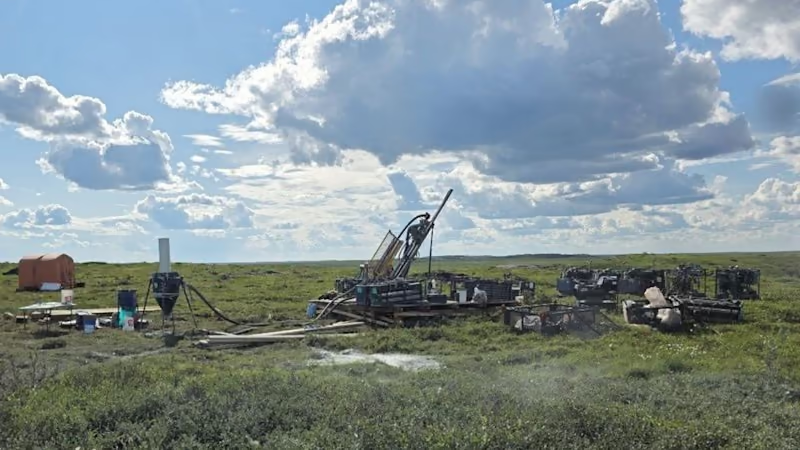
Manhattan Gold Corporation’s inaugural drill program at its Hook Lake tenure in Nunavut has delivered a string of significant results that point to a much larger mineralised system than previously recognised.
The company completed a 25-hole, 4,592-metre maiden campaign that targeted five prospects. At its flagship Jaws prospect the program produced high-grade intercepts including up to 41.15 metres at 4.66 g/t gold, which itself contained 7.62 metres at 18.67 g/t gold.
Drilling at Jaws has now extended the known strike to about 1.25 kilometres, with a 490-metre segment of higher-grade gold within that zone. Mineralisation has been confirmed to be open down to 223 metres and Manhattan says assays from two further Jaws holes are still awaited as it looks to test a potential strike length of more than 2.25 kilometres.
Other notable gold results from the campaign included 74.67 metres at 1.61 g/t gold from 21.34 metres, which contained a higher-grade interval of 15.24 metres at 5.35 g/t and 51.82 metres at 1.88 g/t. The company noted these thicker, higher-grade intersections compare favourably with historical drilling in the area.
Beyond Jaws, Manhattan’s maiden drilling has opened a new polymetallic front at the Spectre prospect, about 26 kilometres to the southwest. One hole intersected massive sulphides, returning 19.81 metres grading 1.77% copper, 0.8 g/t gold, 84.3 g/t silver and 2.30% zinc from 42.67 metres.
Spectre also produced a remarkable shallow, zinc-rich interval of 3.05 metres at 29.50% zinc from 12.19 metres, underscoring the potential for base-metal-rich zones in addition to the orogenic gold signatures at Jaws.
“Spectre has given us a second front, with our maiden drillholes returning high-grade copper, gold, silver and zinc from massive sulphides that start at surface,” said Manhattan Gold technical advisor Sam Vaughan.
Manhattan also completed first-ever drilling at Lotus, Quantum and Omega during the season. Lotus and Quantum returned anomalous gold results, while assays for three holes at Omega, a target aimed at banded iron formation (BIF) hosted gold, are still pending. The company supplemented drilling with extensive geophysical and mapping work, including high-resolution LiDAR and orthophoto surveys and a 12,600 line-kilometre airborne magnetic survey.
The Hook Lake land package covers 665 square kilometres within the Rankin‑Ennadai greenstone belt, an underexplored corridor that hosts Agnico Eagle’s 6.7 million-ounce Meliadine mine to the northeast. Historically, Jaws had a non‑JORC resource estimate of 3.4 million tonnes at 2.38 g/t for about 285,000 ounces, and Manhattan’s results suggest the prospect may warrant a much broader and deeper appraisal.
With a permanent camp now established at Hook Lake to enable winter resupply and an earlier start to the 2027 field season, Manhattan has positioned itself to follow up the most promising targets next year. For investors and explorers watching Nunavut’s emerging mineral frontier, the combination of high-grade gold and substantial polymetallic intersections gives Manhattan multiple avenues to advance the project and potentially broaden the economic case for the district.