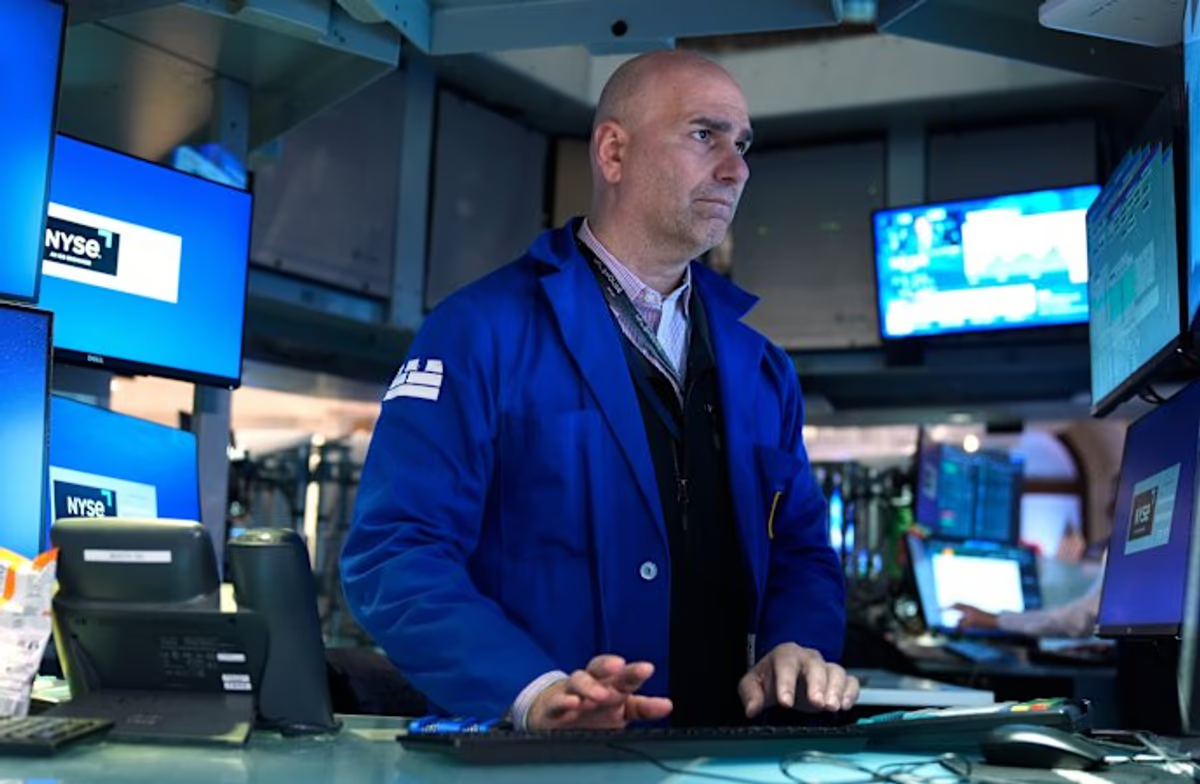
A sharp decline in technology shares on Wall Street knocked the S&P 500 1.8% lower on Friday, the index’s worst day since June, while the Nasdaq fell 2.9% and the Dow dropped 572 points. Australian futures signalled a small fall at the open, down about 4 points, and the Australian dollar was trading near US70.29¢.
The US market remains close to its peak, roughly 3.1% below an all-time high that has boosted retirement account balances, but recent volatility has increased as US midterm elections draw near and investors reassess lofty valuations in AI-related stocks.
Intel led the corporate casualties, plunging 28.6%, its steepest one-day fall since 1974, after issuing a profit forecast for the final quarter that missed analysts’ expectations. The chipmaker's CEO Lip-Bu Tan said the personal-computer market is still under pressure, even though Intel’s latest quarterly profit beat forecasts.
Amazon slid 1.4% after reporting a softer-than-expected profit for the summer and disclosing a large negative free cash flow figure of $US42.4 billion over the prior 12 months. The company also said it spent $US94.8 billion on property and equipment, largely for investments in artificial-intelligence infrastructure.
Earlier in the week Alphabet fell more than 12%, part of a broader theme of technology firms spending heavily on AI and burning through cash. Investors are increasingly asking whether those outlays will translate into higher profits and productivity.
"We’re moving out of the hopes and dreams phase of the AI trade and into the ‘show me’ phase," said Joe Tigay, portfolio manager at Equity Armor Investments.
Nvidia, the poster child of the AI boom, dropped 4.2% and was one of the largest single drags on the S&P 500. Chipmakers and other firms that benefited from the push to build AI data centres have come under pressure amid concerns that higher interest rates could slow further expansion of those facilities.
Cryptocurrency markets were hit after a large hack at Binance. Bitcoin fell to below $US77,000 from highs above $US86,000 earlier in the month, and some crypto-related equities tumbled: Coinbase slid 10.6% despite reporting a stronger quarter, and another firm that says it owns about 4% of bitcoin’s total supply fell 7.8%.
Binance customers withdrew roughly $US3.64 billion, about 2.1% of the exchange’s assets, when the platform came back online after the attack. Binance said it had covered about 95% of the $US6.3 billion of stolen assets.
"Withdrawals were stabilising after an initial spike and deposit volumes had remained "substantial"," Binance said.
In fixed income, investors moved into US Treasuries, sending the 10-year yield down to 4.93% from 4.98% late on Thursday, and well below the month’s peak above 5.30%. Oil prices rose, with Brent crude up 2.4% to $US113.43 a barrel, even as bond yields eased.
Not all sectors suffered: energy stocks climbed after big oil companies reported stronger profits for the summer, with ExxonMobil up 2.2% and Chevron up 1.8%. Consumer goods names also rose after better-than-expected results, including Mondelez, which gained 3.9%, and Colgate-Palmolive, which added 2.3%.
At the close, the S&P 500 dropped 140.32 points to 7,580.07, the Dow fell 572.25 to 51,770.31, and the Nasdaq slid 747.73 to 25,437.00. Markets were left weighing the scale and timing of AI-related capital spending, election-related uncertainty, and a recent stretch of higher interest rates.